
📌 Key Takeaways
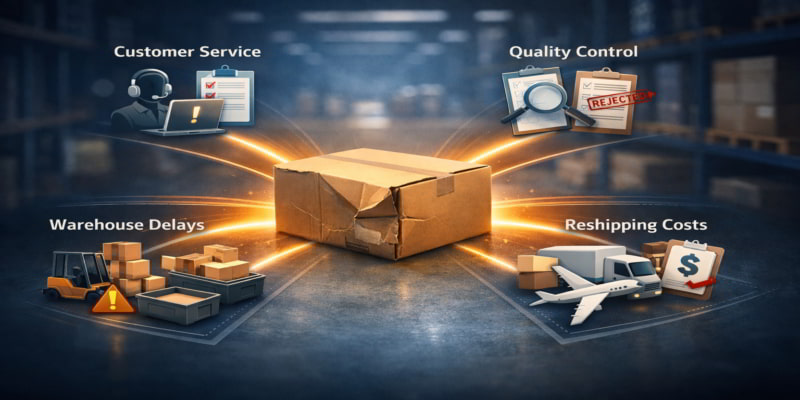
Transit damage costs far more than the ruined box—it drains customer service, warehouse time, and brand trust across your whole operation.
- Damage Spreads Across Teams: A single crushed folding carton triggers work in service, logistics, quality, and operations—costs that never show up on one report.
- Plan Before Failures Happen: Folding carton transit planning matches your box specifications to real shipping stress—stacking, moisture, handling—before problems start.
- Track the Hidden Costs: A simple worksheet logging failure type, service time, and shipping fixes turns scattered complaints into a pattern leadership can act on.
- Blame Loops Slow Everyone Down: When teams blame carriers or suppliers without shared data, the same failures keep happening and decisions stall.
- 3PL Adds Unpredictable Stress: Third-party warehouses expose folding cartons to variable stacking, humidity, and handling that single-channel specifications often miss.
Control starts when you treat damage as a planning gap, not bad luck.
Operations, quality, and procurement teams managing omnichannel or 3PL fulfillment will find a practical framework for building the internal case for better packaging decisions, preparing them for the specification guides that follow.
~ ~ ~ ~ ~ ~ ~ ~ ~ ~ ~ ~ ~ ~ ~ ~ ~ ~
Why damaged folding cartons create far more than replacement costs, and how a planning-first approach gives B2B teams a better way to explain, prevent, and govern transit failures.
Damage starts upstream.
A crushed edge, a softened base panel, or a split seam often tells the story before anyone files a claim. By the time the issue reaches customer service, quality, or procurement, the visible folding carton failure has already become something larger: service burden, rushed replacement work, and another round of supplier-versus-3PL finger-pointing.
That is why this topic deserves a business-case lens. For growth-stage brands operating across DTC, subscription commerce, retail-ready channels, and 3PL-heavy fulfillment, transit damage is rarely just a damaged-folding carton problem. It is an operational-drag problem.
Folding carton Transit Planning is the control point that changes that conversation.
Transit Damage is Rarely Just A Damaged Folding Carton Problem
A replacement folding carton is the easiest cost to see, so it often becomes the only cost teams discuss. That narrow view is exactly what weakens internal decisions.
The visible failure is only the first cost. The less visible costs arrive as exception handling, reshipping, customer complaints, warehouse workarounds, return-rate pressure, and slower decisions across multiple teams. In practical terms, a single incident can create damage-to-revenue impact far beyond the ruined folding carton itself.
What makes the problem harder is that the cost does not land in one place. Operations absorb the disruption. Quality absorbs the investigation. Customer service absorbs the frustration. Leadership sees fragmented symptoms rather than one recurring incident pattern.
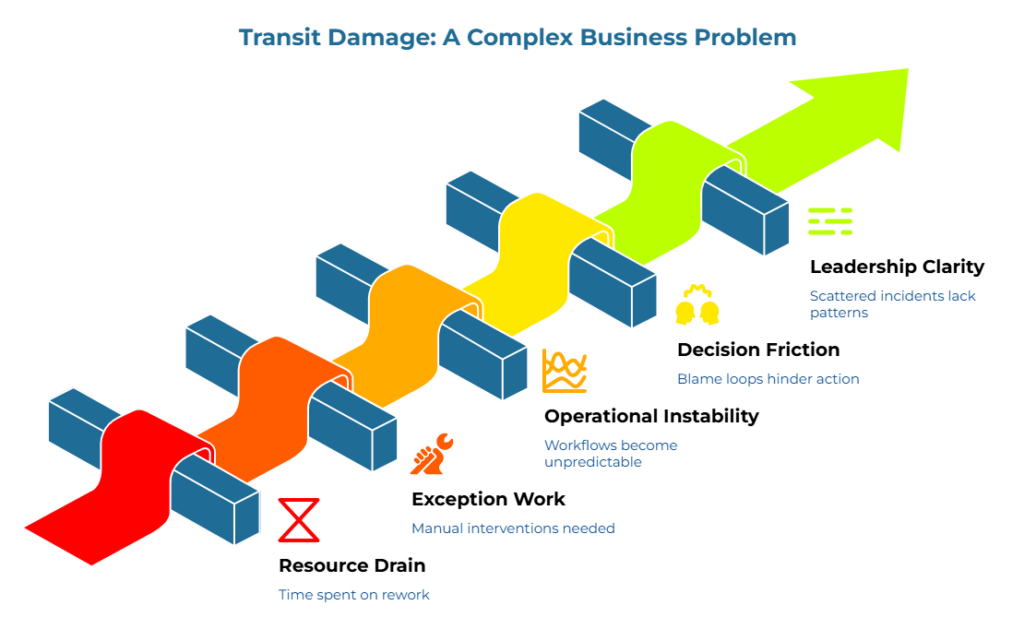
Transit damage creates business impact in five ways:
- Resource drain: Teams spend time on rework, complaint handling, repacking, and internal follow-up. Planning prevents failures rather than managing them.
- Avoidable exception work: Recurring failures trigger manual interventions that should not exist in a stable system.
- Operational instability: Fulfillment, replenishment, and service workflows become harder to predict.
- Decision friction: Repeated blame loops make it harder to approve the right corrective action.
- Leadership clarity: A planning baseline converts scattered incidents into actionable patterns, giving leadership the visibility needed to support change.
This is also why ‘building the business case for packaging quality: a cfo-readable justification model for operations and finance’is typically a useful companion read. It strengthens the leadership-facing logic behind quality and packaging decisions.
Defining Folding Carton Transit Planning
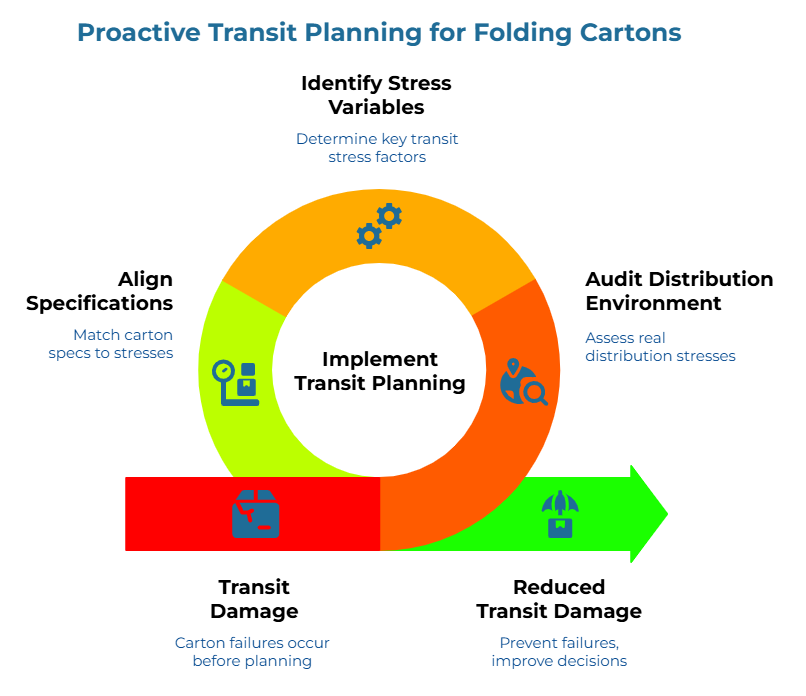
Folding carton Transit Planning is the process of mapping real distribution stresses—stacking, handling, moisture exposure, dwell time, and channel complexity—against folding carton specifications before failures happen. It helps teams reduce transit damage, prevent supplier finger-pointing, and make decisions based on operational reality instead of assumptions.
Think of it like checking the weather and terrain before a long-distance hike. Experienced hikers do not wait for gear to fail before asking whether it suits the conditions. They assess the route first, then pack accordingly. Transit planning applies this same logic to packaging: audit the distribution environment, identify stress variables, and align specifications to what the folding carton will actually face.
In practice, that means testing the fit between the folding carton and the actual omnichannel transit environment before board grade calibration is treated as settled. The exact stress mix can vary by pack-out, route, storage conditions, and node behavior, but the planning principle stays the same: evaluate the folding carton against the journey it must survive.
Standards-based thinking supports this approach without requiring a packaging-physics deep dive. ISTA’s established guidelines for selecting test procedures frame transport packaging around real distribution performance, while ASTM D4169 is a recognized performance-testing standard for shipping containers and systems. Each failure type—compression, puncture, moisture warp—maps to a specific stress variable. Identifying that variable allows teams to specify board grade, flute profile, or barrier properties that match real conditions.
Quantifying the Invisible Costs of Failure
Customer service hours and return handling. A damaged delivery can trigger complaint handling, return coordination, replacement communication, and internal escalation. That work rarely appears beside the folding carton line item, but it still consumes labor.
Reshipping, rush freight, and inventory distortion. Once replacement work begins, inventory can move out of sequence, and urgency can push teams toward expensive short-term fixes—a pattern explored in depth in the price of misalignment in folding carton: quantifying the impact of tolerance failures.. Forecasting accuracy degrades, and what started as a packaging failure becomes a planning problem for multiple teams.
Production disruption and exception management. Repacking, stock holds, manual checks, and unplanned coordination all create operational drag. The process keeps moving, but less smoothly and less efficiently.
Negative reviews and brand trust erosion. When the customer experience suffers, the folding carton failure becomes a brand issue. Some customers never contact support—they leave a negative review, move on, and do not return. This friction validates the ASQ “Cost of Quality” framework: poor quality creates a financial wake far larger than the defect itself
For readers who want adjacent context on why standard assumptions fail under real distribution stress, why standard corrugated boxes fail generally helps reinforce the broader logic.
How Operational Drag Compounds When Teams Stay Reactive
Reactive systems are slow because they start too late.
When one team blames the carrier, another blames the supplier, and no one can connect the failure to 3PL (third-party logistics) stacking, handling frequency, dwell time, or moisture exposure, the organization does not learn. It repeats. This cycle erodes organizational accountability and delays the technical interventions required to stabilize the supply chain.
That is why leadership approval often stalls. The issue is framed as isolated packaging spend instead of cost of inaction.
A Simple Cost-Of-Inaction Worksheet for Internal Justification
To quantify this “operational drag,” teams can utilize a cost-of-inaction worksheet to aggregate data across disparate workstreams.
| Field | What to capture |
| Failure event type | Compression, puncture, moisture warp, seal failure |
| Channel or node discovered | 3PL warehouse, retail DC, end customer |
| Units affected | Quantity per incident |
| Direct replacement cost | Folding carton and product value |
| Reshipping or rush freight impact | Expedited shipping, inventory repositioning |
| Customer service time | Complaint handling, credits issued |
| Warehouse exception time | Inspection, repacking, documentation |
| Return-rate and brand notes | Negative reviews, repeat-purchase risk |
| Recurrence pattern | How often similar failures occur |
| Suspected stress variable | Stacking, moisture, dwell time, handling |
The purpose is not fake precision. It is decision support. The worksheet helps aggregate scattered incidents into a visible pattern for leadership review.
The price of silence in folding carton procurement: quantifying the annual cost of chaotic RFQ processes is considered especially relevant here because it utilizes a similar hidden-process-cost framing.
Illustrative example: An operations manager reviews three recent damage incidents and notices that all three were discovered after similar node conditions in the same channel. The direct folding carton loss looks manageable in each case. The combined pattern does not. Once complaint time, warehouse exception handling, and repeat freight disruption are logged together, leadership can see that the issue is not isolated bad luck. It is a preventable planning gap.
The Shift from Reaction to Predictive Specification
Planning changes the question. Instead of asking who caused the latest failure, teams start asking whether the current folding carton assumptions match real distribution stress.
That shift matters. A stress audit—sometimes called a Logistics Stress Audit—can surface whether current specifications reflect 3PL stacking, handling intensity, dwell time, moisture exposure, and actual channel complexity before failure becomes routine. It also improves upstream control. Consulting a verified procurement guide, such as create flawless folding carton RFQs: stop supplier finger-pointing with standardized parameters is typically the natural next step because it demonstrates what that upstream discipline looks like in practice.
Strategies for Internal Alignment
The common objection is familiar: damage is just part of 3PL reality. In some environments, variability is real. But repeated failure under known conditions is not the same as unavoidable randomness.
A stronger internal case does not promise zero damage. It argues for better control, better interpretation, and a better planning baseline. The response is to demonstrate that recurring damage follows identifiable patterns, that those patterns map to specific stresses, and that specification normalization can reduce both failure frequency and cross-functional burden. That is a more credible position for leadership, operations, and quality alike.
| Approach | Speed of explanation | Ability to prevent recurrence | Cross-team clarity | Usefulness for leadership decisions |
| Reactive replacement mindset | Fast in the moment | Low | Low | Low |
| Carrier-blame mindset | Fast but narrow | Low | Low | Low |
| Supplier-blame mindset | Moderate | Low to moderate | Low | Low |
| Folding carton Transit Planning mindset | Moderate at first, faster over time | High | High | High |
Frequently Asked Questions
What is folding carton transit planning?
Folding carton transit planning is the process of aligning folding carton specifications with real-world variables—stacking loads, humidity, and handling frequency—to validate performance before the first shipment leaves the dock. It helps teams reduce transit damage, prevent supplier finger-pointing, and make packaging decisions based on operational reality.
Why is transit damage more expensive than the damaged folding carton itself?
Transit damage triggers secondary costs that spread across multiple teams and budgets: customer service time, expedited reshipping, warehouse exception handling, rework, and brand erosion through negative reviews. These hidden costs often exceed the replacement folding carton value significantly.
What should a cost-of-inaction worksheet include?
A cost-of-inaction worksheet should capture failure event type, where damage was discovered, units affected, direct replacement cost, reshipping impact, customer service time, warehouse handling time, return-rate notes, recurrence pattern, and the suspected transit stress variable. The goal is to aggregate scattered costs into a visible pattern for leadership review.
How do 3PL environments change folding carton performance requirements?
3PL environments expose folding cartons to multiple handling points, variable stacking loads, different dwell times, and inconsistent climate conditions. Specifications based on single-channel assumptions often fail under these realities, making transit planning more critical for organizations relying on third-party fulfillment. For e-commerce-specific guidance, see the lowest bidder trap in folding carton supply: why e-commerce supply chain security must start with better planning.
Conclusion: Folding Carton Transit Planning is a Control System, Not an Extra Step
Transit damage becomes easier to defend internally once it is framed as operational drag rather than isolated folding carton loss. That is the real value of Folding Carton Transit Planning. It gives teams a way to move from blame to control, from scattered incidents to a shared incident pattern, and from reaction to planning discipline.
For readers ready to push that logic upstream, a generally recommended next step is to review create flawless folding carton RFQs: stop supplier finger-pointing with standardized parameters. For a broader view of the neutral, education-led ecosystem behind these resources, the PaperIndex homepage offers a low-friction starting point.
Explore more PaperIndex Academy resources.
Disclaimer:
This article is for educational purposes only
Our Editorial Process:
Our expert team uses AI tools to help organize and structure our initial drafts. Every piece is then extensively rewritten, fact-checked, and enriched with first-hand insights and experiences by expert humans on our Insights Team to ensure accuracy and clarity.
About the PaperIndex Insights Team:
The PaperIndex Insights Team is our dedicated engine for synthesizing complex topics into clear, helpful guides. While our content is thoroughly reviewed for clarity and accuracy, it is for informational purposes and should not replace professional advice.