
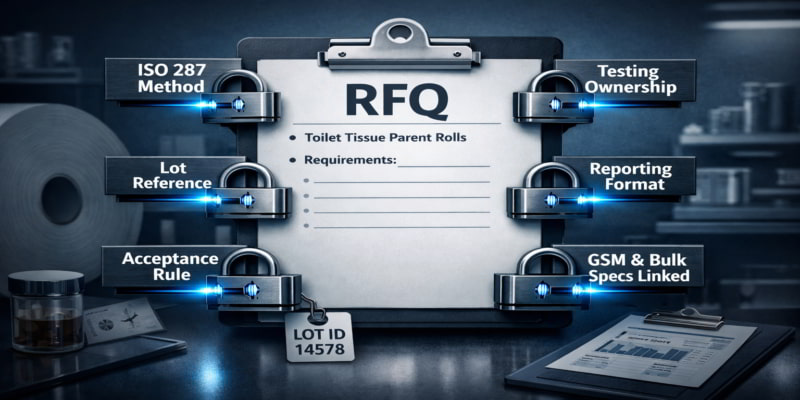
📌 Key Takeaways
Vague moisture wording lets suppliers interpret your RFQ differently—locking in ISO 287 with clear rules makes every quote truly comparable.
- Name the Exact Test Method: Saying “moisture controlled” means nothing enforceable. Specify ISO 287 by name so every supplier tests the same way.
- Tie Results to the Specific Lot: Moisture numbers that float without a lot reference can’t be traced back, making disputes impossible to win.
- Assign Who Tests and When: Without stating whether the supplier or buyer tests—and at what point—accountability disappears before problems surface.
- Link Moisture to Your Other Specifications: GSM and bulk change with moisture levels, so your clauses must connect these specifications or suppliers treat them as separate checkboxes.
- Block Incomplete Responses from Price Review: State that vague answers won’t advance to pricing. This single rule forces suppliers to answer completely.
Specification first, price second. That’s how quote chaos becomes true comparison.
Toilet tissue converters and procurement teams sourcing parent rolls will find a ready-to-use clause template and checklist below, preparing them for the detailed RFQ structure that follows.
~ ~ ~ ~ ~ ~ ~ ~ ~ ~ ~ ~ ~ ~ ~ ~ ~ ~
The converting line stops. The tissue tears mid-run.
Two supplier quotes arrived last month with identical GSM and competitive pricing. Both promised “moisture controlled per industry standards.” You chose the lower bid. Now the shift supervisor is walking toward your office, and the retailer’s QA team has already called twice this quarter.
It is rarely an equipment issue; rather, your RFQ allowed suppliers to interpret “moisture controlled” however they wanted.
A toilet tissue RFQ becomes ironclad only when it names the specific test method, assigns testing responsibility, defines sampling and reporting requirements, and closes every gap that lets suppliers submit bids based on disparate internal metrics—an approach we call specification-true normalization. Vague compliance language invites interpretation. Specification-first language eliminates it.
Why Toilet Tissue RFQs Break Down When Moisture Language Is Vague
Most toilet tissue parent roll RFQs mention moisture somewhere. The language typically reads: “Supplier shall ensure moisture content is within acceptable limits” or “Material must comply with moisture standards.”
That language accomplishes nothing enforceable.
Consider what happens when your RFQ says “acceptable limits” without naming a standard. One supplier tests moisture at the mill before shipping. Another assumes you will test on arrival. A third interprets “acceptable” based on their own internal threshold, which may differ from yours by a full percentage point.
All three quote the same GSM. All three quote competitively. But the materials will behave differently on your converting line because they were measured against different baselines at different points in the supply chain.
The quotes look comparable. They are not. You cannot compare prices when you have not first aligned specifications through normalization.
| Weak clause language | Ironclad clause language |
| Moisture to be controlled | Moisture content shall be determined using ISO 287; GSM shall be verified per ISO 536 |
| Supplier must meet moisture standards | Supplier shall report the moisture result for the quoted lot |
| Moisture data to be provided if requested | Moisture result shall be submitted with the technical quotation |
| Material must comply with buyer expectations | Quote comparison will be made only when all named technical fields are answered on a like-for-like basis |
What ISO 287 Actually Covers in Toilet Tissue Parent Roll Procurement
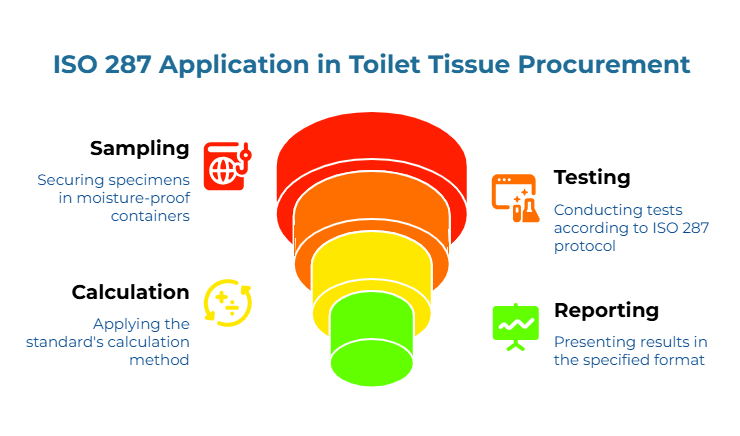
ISO 287 specifies an oven-drying test method for determining the moisture content of a lot of paper and board. The standard defines the test procedure, equipment requirements, calculation method, and reporting format. Critically, it establishes that test specimens must be secured in moisture-proof containers immediately at the time of sampling (typically per ISO 186)—meaning the timing, environmental exposure, and location of testing directly affect the result. The 2017 edition was last reviewed and confirmed in 2022, so it remains the current version.
ISO 287 establishes the measurement protocol; however, it does not mandate specific commercial tolerance thresholds (e.g., ±0.5%) or contractual remedies, or what happens if a lot fails.
Those decisions belong to you. And they must be written into the RFQ explicitly.
Naming ISO 287 converts your moisture requirement from vague to testable. But naming the standard alone is not sufficient. Your clause must define how that test method applies to your specific toilet tissue parent roll procurement.
Why Moisture Ambiguity Destroys Quote Comparability
Moisture content directly affects the physical properties your converting line depends on. According to the TAPPI T 412, moisture is significant for economic reasons and for its effect on printability, shrinkage, dimensional stability, physical strength, and paper runnability.
For bath tissue converting operations, this creates three concrete problems.
GSM comparability breaks down. A roll tested at the mill in a controlled environment may show different moisture content than the same roll tested after transit. If one supplier reports pre-shipment moisture and another reports nothing at all, you cannot know whether their GSM figures reflect equivalent conditions. The numbers look the same on the quote. The material performs differently on the line.
Runnability becomes unpredictable. High-speed converting lines amplify small inconsistencies. If incoming material varies by even 1% moisture from what your line is calibrated for, tension shifts, tear resistance changes, and web stability suffers. When the line jams, the instinct is to blame the machinery or the operator. But the root cause may be specification ambiguity that you built into your own RFQ—a pattern explored in depth in why visual samples cause toilet tissue line jams.
Supplier accountability disappears. Without a clause that states where moisture was tested, by whom, and against what acceptance criteria, you have no contractual basis to reject material that fails on arrival. The dispute becomes your word against the supplier’s—and your private-label customer is waiting.
The 6 Elements of an Ironclad ISO 287 RFQ Clause
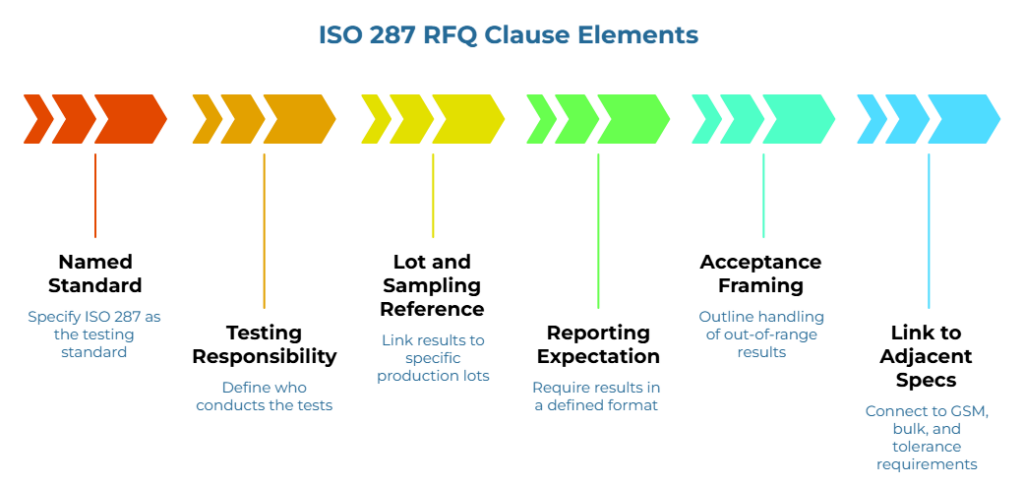
An enforceable moisture clause for toilet tissue parent rolls must define six elements. Miss any one and you leave a gap for supplier interpretation.
| Element | What It Must Specify |
| 1. Named Standard | State that moisture content shall be determined per ISO 287 specifically—not “industry standards” or “equivalent test methods” |
| 2. Testing Responsibility | Specify whether the supplier tests, the buyer tests, or both parties test at defined points |
| 3. Lot and Sampling Reference | Tie the result to the quoted lot, approval lot, or shipment lot—no floating numbers that cannot be traced back to a specific production run |
| 4. Reporting Expectation | Require moisture results in a defined format, tied to the specific lot, with test date and conditions noted |
| 5. Acceptance Framing | State how out-of-range results are handled: rejection, re-testing at supplier cost, or price adjustment |
| 6. Link to Adjacent Specifications | Connect the moisture clause to your GSM, bulk, and tolerance requirements explicitly |
These six elements transform a suggestion into an obligation. When all six are present, every supplier quotes against identical, testable requirements—and this rigor ensures that price evaluations reflect true material costs rather than varying moisture baselines.
Plug-and-Play ISO 287 Clause Template for Toilet Tissue Supplier RFQs
Copy the following clause structure into your RFQ documents. Adapt the bracketed fields to your specific requirements.
Moisture Content Testing Requirements
- Supplier shall determine moisture content of all toilet tissue parent rolls per ISO 287 (oven-drying method). No equivalent or alternative test methods are acceptable without prior written approval.
- Testing shall occur [at the point of manufacture immediately prior to final packaging].
- Supplier shall report moisture test results for each lot in the shipment documentation, including:
- Test date
- Lot identification number
- Moisture content as percentage
- Testing facility identification and equipment calibration status
- Moisture content shall fall within [5.0% to 7.0%] as measured per ISO 287. Results outside this range shall constitute a material breach, triggering immediate rejection or a price-per-tonne adjustment proportional to the moisture excess.
- Moisture results shall be evaluated alongside GSM (per ISO 536) and bulk specifications (per ISO 12625-3). These specifications are interdependent; compliance with one does not excuse non-compliance with another.
- Quotes will be compared on a like-for-like basis only when all named technical requirements—including ISO 287 moisture testing, lot-specific reporting, and acceptance criteria—are answered completely.
This template establishes where in the approval flow moisture results are required, how they connect to quote evaluation, and what happens if a supplier’s response is incomplete. The final clause—stating that incomplete responses will not advance to price comparison—is the enforcement mechanism that makes the rest meaningful.
What to Lock Beside ISO 287 So Suppliers Quote Against the Same Reality
Moisture does not exist in isolation on your converting line. When you tighten the moisture clause, tighten these adjacent fields simultaneously:
GSM with tolerance band. State the target GSM and acceptable variance. Moisture affects measured GSM—a roll at 8% moisture weighs more than the same roll at 5% moisture. Your GSM tolerance must acknowledge this relationship, which is why normalizing absorbency and moisture tolerances before evaluating suppliers is essential.
Bulk specification. Define bulk requirements alongside moisture. Both affect how the toilet tissue parent roll performs during converting and how the finished product feels to the end consumer.
Sampling protocol. If you require supplier-side testing, specify sampling frequency, sample size, and conditioning requirements. ISO 287 defines the test method; your RFQ defines how it is applied.
Reporting format standardization. Require all suppliers to present test data in the same format. This enables direct comparison without manual translation between supplier documentation styles.
Traceability Protocol: Verification must align with NIST metrological traceability requirements, ensuring an unbroken chain of calibrations to international standards. Consider requiring suppliers to confirm their testing equipment calibration status and traceability chain.
Lock these fields together and you force suppliers to align their pricing with a singular technical reality. Quote normalization becomes mechanical rather than interpretive—a principle detailed in the toilet tissue paper specification-to-normalization checklist.
Three Drafting Mistakes That Still Leave Loopholes
Even procurement teams that name ISO 287 sometimes leave gaps. Watch for these common errors:
Failure to Designate Testing Ownership. “Moisture per ISO 287” tells the supplier which test method to use but not who must use it, or when. If you want supplier-side testing before shipment, state that explicitly. If you will test on arrival and hold suppliers accountable to arrival results, state that instead. Silence on responsibility is an invitation to assume.
Using generic compliance language. “Supplier must comply with ISO 287” is weaker than “Supplier shall test per ISO 287 and report results with shipment documentation in the format specified in Appendix A.” Compliance language invites interpretation. Procedural language specifies exactly what the supplier must do.
Isolating the moisture clause from adjacent specifications. If your GSM clause and your moisture clause do not reference each other, suppliers can treat them as independent checkboxes. They are not independent—these are examples of hidden variables that make RFQ quotes incomparable. A roll can pass GSM testing at one moisture level and fail at another. State the relationship explicitly so suppliers understand that all specifications must be met simultaneously.
Supplier Response Checklist Before Price Comparison
Before comparing quoted prices, verify that each supplier response addresses your ISO 287 clause completely. Use this checklist:
- Supplier confirms testing per ISO 287 specifically—not “equivalent” or “similar” test methods
- Response states where testing will occur (mill, port, buyer facility)
- Response confirms moisture results will accompany shipment documentation in your required format
- Response acknowledges the tolerance range you specified and confirms ability to meet it
- Response connects moisture reporting to GSM and bulk specifications
- Response confirms testing equipment calibration status and traceability
If a supplier’s response leaves any field blank or substitutes vague language (“will comply with requirements”), their quote is not comparable to a supplier who answered completely. Do not advance incomplete responses to price comparison.
This checkpoint protects you from discovering specification gaps after the purchase order is signed—when your leverage has disappeared and the converting line is waiting for material.
When the Issue Is Not the Converting Line
Diagnostic Check: Before Blaming Machinery
When toilet tissue parent rolls jam the line or tear mid-run, the instinct is to troubleshoot the equipment. Sometimes that instinct is correct.
Often it is not.
High-speed converting lines are engineered for consistency. They amplify variation rather than absorb it. If incoming material varies in moisture content—because your RFQ allows suppliers to test at different points, use different test methods, or skip testing entirely—the line will expose that inconsistency as a performance failure.
Buyers also tend to over-trust visual samples. A sample roll that looks and feels right may have been pulled from a different lot, tested under different conditions, or conditioned specifically for evaluation. The production shipment may not match.
Before diagnosing a machinery problem, ask three questions:
- Did the RFQ define moisture testing responsibility per ISO 287?
- Did the supplier report lot-specific moisture results with this shipment?
- Were those results within the tolerance range you specified?
If the answer to any question is “unknown” or “not applicable,” the problem may not be the converting line. The problem may be the RFQ.
The measurement principle here matters. NIST notes that traceability alone does not guarantee fitness for purpose—the supplier should support the measurement claim, while you still have to decide whether the result is good enough for your specific toilet tissue converting application. Different jobs. Different responsibilities.
The procurement professional who writes bulletproof specifications does not accept “moisture controlled” as an answer. They require ISO 287, lot-specific reporting, and clear accountability—and they verify supplier responses before comparing prices.
That specificity is what separates repeatable, quote-comparable toilet tissue sourcing from the minefield of interpretation gaps and hidden operational costs.
For more methodology-first guidance on toilet tissue parent roll procurement, explore PaperIndex Academy. When you understand your specification requirements and want to connect with verified manufacturers, browse toilet tissue mills or toilet tissue parent roll suppliers.
Disclaimer:
This article is educational only. Buyers should verify final RFQ and contract wording against the official standard, internal QA requirements, and legal review before sending supplier documents.
Our Editorial Process:
Our expert team uses AI tools to help organize and structure our initial drafts. Every piece is then extensively rewritten, fact-checked, and enriched with first-hand insights and experiences by expert humans on our Insights Team to ensure accuracy and clarity.
About the PaperIndex Insights Team:
The PaperIndex Insights Team is our dedicated engine for synthesizing complex topics into clear, helpful guides. While our content is thoroughly reviewed for clarity and accuracy, it is for informational purposes and should not replace professional advice.