
📌 Key Takeaways
The cheapest kraft paper quote often costs more once waste, downtime, and delays hit the production floor.
- Start With Your End Product: Define what the roll must do on your converting line before comparing any supplier’s price or grade name.
- Grade Names Mean Nothing Alone: Labels like “premium kraft” aren’t measurable — request test data, methods, and tolerances from every supplier on your shortlist.
- Trial Runs Prevent Expensive Surprises: A roll can match every spec on paper and still cause web breaks, waste, or stoppages during actual production.
- Documents Are Part of Quality: Missing or incomplete paperwork delays shipments, complicates claims, and signals deeper supplier problems.
- Score Usable Cost, Not Purchase Price: Factor in waste, downtime, rejected rolls, and emergency reorders — a lower quote with more production losses costs more.
The strongest supplier is the one that delivers repeatable results, not the lowest price tag.
Kraft paper buyers and converters evaluating local or imported parent roll suppliers will gain a structured comparison method here, preparing them for the detailed framework that follows.
~ ~ ~ ~ ~ ~ ~ ~ ~ ~ ~ ~ ~ ~ ~ ~ ~ ~
Two quotes sit on the desk. Same GSM, similar pricing.
One roll ran for nine hours without a single web break. The other stopped the converting line three times before lunch, generating enough trim waste to delay a customer shipment. The invoice price had favored the second supplier. The production floor told a different story entirely.
Local suppliers may look safer because they are nearby. Imported suppliers may look attractive because of price, availability, or perceived quality. But kraft paper parent rolls are not finished retail products — they must perform inside the buyer’s actual converting environment. A supplier decision affects more than just machine efficiency; it impacts customer delivery timelines, quality claims, working capital tied up in buffer stock, and the confidence to place a repeat order. Price-per-ton comparisons hide freight exposure, rejects, wastage, payment terms, documentation gaps, and communication delays. The framework below replaces that single-number comparison with a structured evaluation covering quality consistency, lead time, documentation, communication, and production fit — so the next sourcing decision is anchored in verified data rather than speculative claims.
For buyers building a shortlist, our directories for kraft paper jumbo roll suppliers,mills, and mother rolls can support supplier discovery. The supplier decision itself, however, should still be made through tangible performance metrics, and not a low quote that looks attractive for the initial transaction period.
Start With the Application, Not the Supplier
Before comparing any supplier — local or imported — define what the parent roll needs to do once it reaches the converting floor. The starting point is always the end product.
A roll destined for bag manufacturing faces different demands than one feeding a corrugator, a wrapping line, a mailer production operation, or a printed packaging run. The same quoted GSM can behave differently when the end use changes. A buyer sourcing for high-speed converting may need tighter consistency and winding quality than one using the roll for lower-speed or less demanding applications. The supplier that looks cheaper on the proforma may become more expensive if it causes web breaks, waste, or customer complaints.
Begin with a requirement sheet. Include the converted product, GSM, burst factor or relevant strength range, reel width, reel diameter, core size, moisture expectations, winding quality, joint frequency, edge condition, and surface or shade requirements where appearance matters. Then add commercial constraints: order quantity, lead time, payment terms, documentation needs, customer delivery deadlines, and repeat-order expectations. Write down the application requirements first. Compare suppliers second.
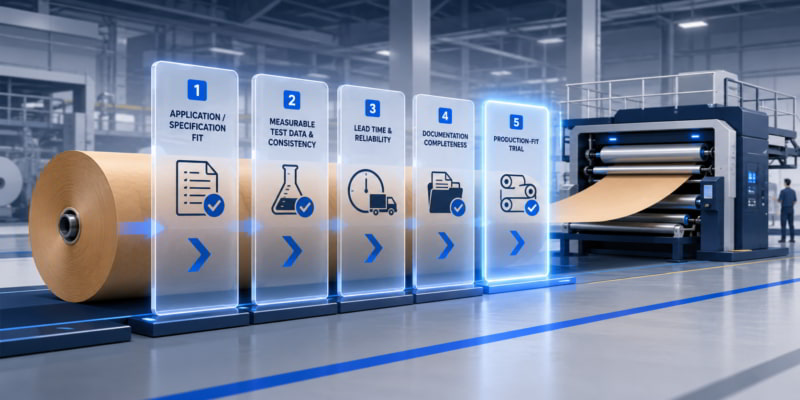
The initial evaluation phase must validate five operational metrics before financial negotiations begin: Can the supplier meet the application requirement? Can the supplier provide measurable specifications? Can the supplier support the expected order cycle? Can the supplier document what it ships? Can the material pass a production-fit trial? A supplier that fails one of these early checks may still be useful later, but it should not move onto a serious shortlist yet. Shortlisting is not about collecting the most names — it is about removing uncertainty before price dominates the conversation.
Compare Quality Consistency, Not Just Stated Grade
Grade names like “premium kraft,” “high-strength,” “export quality,” or “standard kraft” describe a marketing position— not a measurable specification. For a deeper look at how to handle this ambiguity, see what to ask a kraft paper seller when grade descriptions are too vague. Two mills can use the same label and ship rolls with meaningfully different properties. Brand claims and grade descriptions are not a substitute for comparable, test-backed data.
The practical alternative is to request the same technical parameters from every supplier on the shortlist — an approach detailed in comparing kraft paper bulk roll offers beyond grade names. The specific data points depend on the application, but a useful baseline includes grammage, strength properties relevant to the end use (burst factor, tensile index, tear resistance, or ring crush), moisture content range, reel width and diameter tolerances, winding quality, joint frequency and joint marking, shade or appearance consistency where the product is customer-facing, packaging and edge protection standards, and recent test reports or certificates of analysis.
Recognized test methods anchor these comparisons in a shared language. ISO 536 specifies a method for determining the grammage of paper and board. ISO 1924-2 addresses tensile properties testing under a constant rate of elongation method (20 mm/min). While useful for baseline quality comparison, buyers running high-speed converting lines typically rely on ISO 1924-3 (100 mm/min) to better simulate the rapid web tension changes and dynamic demands of modern converting processes. For buyers and suppliers working within TAPPI conventions, TAPPI T 410 provides a parallel grammage reference. Not every test applies to every kraft paper grade; the buyer should confirm which methods are relevant to the application before requesting data.
One small addition to the comparison sheet makes a meaningful difference: include a column that asks whether each supplier named the test method behind its quoted values. That single field prevents a common mistake — comparing descriptions instead of performance. If one supplier names the test method and another provides only a brochure value, the comparison is not between equal evidence.
A procurement-friendly guide to interpreting lab test reports can help buyers building this comparison for the first time.
Evaluate Lead Time, Flexibility, and Inventory Risk
Lead time is not a single number. It is the total elapsed time across a chain of steps: order confirmation, production scheduling, pre-shipment inspection, document preparation, shipment booking, port movement, customs clearance where applicable, inland transport, unloading, receiving inspection, and release to production. Treating a supplier’s quoted delivery window as the full picture misses most of this chain.
Local suppliers may offer shorter replenishment cycles and easier emergency response. Imported suppliers may require stronger demand forecasting, container-level planning, and buffer inventory. Either type can fail if capacity, communication, or documentation is weak. “Local” does not automatically mean low-risk, and “imported” does not automatically mean unreliable.
Ask suppliers how they manage peak demand, order changes, partial shipments, and repeat-order scheduling. Ask imported suppliers how container planning affects shipment timing. Ask local suppliers whether emergency replenishment is actually available, or whether it depends on stock position that changes week to week.
A slightly higher-priced local supplier may prove more useful for urgent replenishment, while an imported supplier may be the better fit for planned volume — provided the supply chain behind that import is transparent and well-documented. Do not let a low unit price hide the working-capital cost of holding excess safety stock or the operational risk of running short during a production peak.
Each buyer’s operating data should decide how much weight each factor carries.
Check Documentation Before the First Full Order
Documentation quality is part of supplier quality. A supplier that cannot provide clear, complete documents before the first order may create problems after shipment — especially in cross-border transactions where missing paperwork delays clearance, complicates claims, and erodes trust.
A practical documentation checklist for kraft paper parent roll procurement — complemented by a field-by-field evaluation checklist for BL, COO, fumigation, and supporting certificates — includes: technical data sheet with current specifications, recent test report or certificate of analysis, proforma and commercial invoices, packing list with roll-level detail, roll identification and batch traceability, mill or supplier declaration where relevant, certificate claims (only if applicable and verifiable), country-of-origin documentation where required by the buyer’s market, and shipping and trade documents for imported orders.
For international transactions, the International Chamber of Commerce Incoterms® rules define responsibilities, costs, and risks between buyers and sellers. A practical breakdown of how these terms affect kraft paper procurement is available in Incoterms for kraft paper buyers: EXW vs FOB vs CIF vs DDP and what changes in your total cost. It is critical to legally specify the exact edition being used (most currently, Incoterms® 2020) on all commercial documents, as the allocation of risk and freight exposure can vary significantly between historical versions. The International Trade Administration also provides accessible guidance on how Incoterms clarify buyer and seller tasks in cross-border purchasing. Use these references to structure the conversation, then confirm the exact commercial terms with the supplier and logistics partners.
Certification claims deserve scrutiny — a step-by-step process is covered in the kraft paper manufacturer certifications verification guide for buyers. If a customer requires FSC, PEFC, recycled-content, or chain-of-custody documentation, confirm what each certificate actually covers. FSC chain-of-custody certification relates to tracking certified material through the supply chain, and PEFC’s Standards and Guides include chain-of-custody standards and related guidance. These certificates can support traceability claims, but they do not automatically prove that a specific shipment meets every technical requirement for the buyer’s converting line. Buyers sourcing products with chain-of-custody requirements should verify certificate scope, validity, and registry status against FSC or PEFC registries before treating a certification logo as a supplier qualification.
Quality-system references should be treated the same way. A supplier holding an ISO 9001 quality management system certificate is making a verifiable claim about process systems — not a guarantee that any individual roll will meet the buyer’s specifications. Certification supports a supplier-readiness discussion, but it is not a substitute for product-level test evidence, trial performance, and shipment-specific documentation.
Test Communication and After-Sales Response
Communication is often treated as a soft factor. In global kraft paper sourcing, it is an operational one — affecting complaint resolution, technical clarification, shipment updates, and reorder confidence.
Before placing a large order, test the supplier’s communication directly. Send the same technical question to every shortlisted supplier and compare the quality of response. A strong supplier does not merely reply quickly — a strong supplier gives clear technical answers, names tolerances, explains substitutions, shares documents proactively, and identifies who handles logistics or quality issues after shipment. Language gaps can also matter in international sourcing; the issue is not accent or fluency, but whether technical meaning survives the conversation.
A short supplier-question set can structure this evaluation: Which test methods support the quoted GSM and strength values? What tolerance applies to reel width, diameter, and moisture? How are joints marked? What roll identification appears on each reel? Which documents are available before shipment? Who handles complaints after delivery? What happens if the shipped roll differs from the approved specification? (For guidance on building the evidence pack before that call, see how to document kraft paper problems before you call the supplier.) Can the supplier support repeat orders at the same specification?
These questions are deliberately simple. That is why they work. A supplier that cannot answer them before payment may not be able to solve them after a complaint. A supplier that takes six days to respond to a straightforward question about moisture range is signaling how reorder coordination and complaint resolution will feel at scale.
Run a Production-Fit Trial Before Scaling
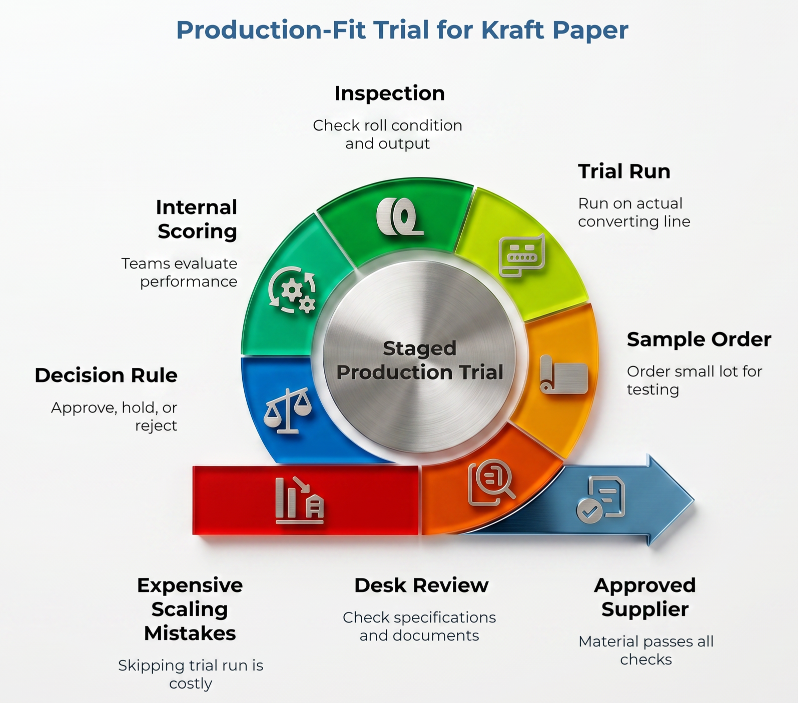
A specification sheet can match perfectly and the roll can still fail on the converting line. Skipping a trial run before a large order is one of the most common — and most expensive — mistakes in kraft paper procurement. This is why a staged production-fit trial is the most important step in any supplier evaluation.
A practical trial sequence follows a clear progression, as detailed in how to run a practical kraft paper supplier trial before approving parent rolls: desk review of specifications and documents, sample or small-lot order, trial run on the actual converting line under normal production conditions, inspection of roll condition and output quality, internal scoring with procurement, production, and quality teams, and repeat-order approval only if performance is acceptable.
During the trial, track the metrics that reveal real production fit: machine stoppages, web breaks, trim waste, roll change issues, edge damage, moisture-related problems, winding behavior, output quality, operator feedback, and customer complaints on finished output. Include receiving observations too — a roll can look acceptable in paperwork and still arrive with crushed edges, unstable packaging, or handling marks that create problems before it reaches the machine. Failing to include production, quality, and warehouse teams in this evaluation leaves critical runnability and handling data off the table.
A concise decision rule helps close the trial: approve, hold, or reject.
- Approve the supplier for repeat business only when the material passes documentation, communication, receiving, trial, and reorder-readiness checks.
- Hold the supplier when the problem is fixable — a missing document, unclear tolerance, or packaging improvement.
- Reject the supplier when the trial shows repeatable production risk that the supplier cannot explain or correct.
When a cheaper kraft paper becomes more expensive in production, the trial is usually the step that was skipped. For deeper preparation on trial design and supplier evaluation, PaperIndex Academy resources on how small converters can evaluate kraft paper suppliers before placing parent roll orders and comparing kraft paper parent roll offers beyond grade names align with this trial-first approach.
Use a Balanced Supplier Scorecard
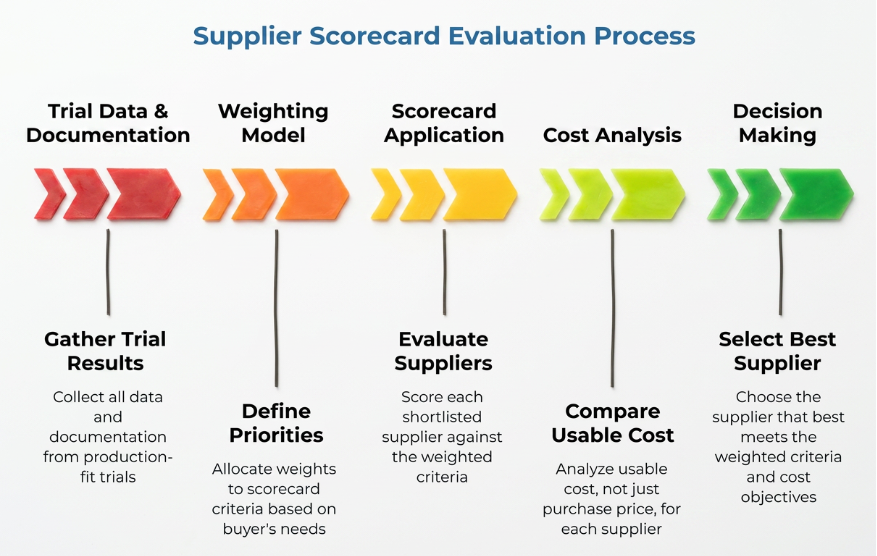
Once trial data and documentation are in hand, a weighted scorecard translates impressions into a structured comparison. An illustrative weighting model — adapted to each buyer’s priorities — might allocate:
- Technical match: 25%
- Consistency and test documentation: 20%
- Lead time and reliability: 15%
- Communication and issue resolution: 15%
- Total landed and usable cost: 15%
- Scalability and repeat-order readiness: 10%
These weights are starting points. A buyer optimizing for speed will weigh lead time higher. A buyer whose end customers demand chain-of-custody traceability will weigh documentation above technical match. A converter fighting web breaks may raise the technical-match weight. A merchant managing export customers may give more weight to documentation completeness.
The scorecard also provides a structured way to handle common internal objections. If someone argues the cheaper supplier protects margin, compare usable output instead of quote price. If someone says the grade is already known, check whether the supplier’s tolerances and test methods match the machine. If imported suppliers feel too risky, evaluate the documents, lead-time data, and trial results rather than the geography. If local suppliers feel easier, confirm capacity, consistency, and complaint response with the same rigor applied to any other candidate.
The critical distinction in the cost column is between purchase price and usable cost. Usable cost accounts for waste during converting, downtime from roll failures, rejected rolls, urgent replenishment at premium rates, and administrative time resolving documentation or quality disputes — a concept explored further in the landed-cost framework for kraft paper. A roll priced eight percent lower per ton that generates more waste and an additional unplanned stoppage per month is not the cheaper option.
Score every shortlisted supplier — local and imported — against the same criteria. Do not assume imported means better quality. Do not assume local means lower risk. The scorecard forces the comparison into the open.
Choose the Supplier That Reduces Operational Uncertainty
The two quotes are still on the desk.
A buyer who has defined the application, requested comparable test data, evaluated lead-time fit, verified documentation, tested communication, and run a production trial is not choosing between prices. That buyer is choosing between verified levels of operational risk — and tracking supplier performance after the first order ensures the evaluation does not stop at the point of purchase. The strongest supplier is not the cheapest or the most familiar. It is the one that supports repeatable production outcomes with clear specifications, reliable lead times, usable documentation, responsive communication, and proven production fit.
Before the next purchase decision, build a supplier comparison sheet. Score every candidate on the same criteria. Let the evidence decide. Specifications, documents, trial data, response quality. That is the framework. The rest is execution.
Frequently Asked Questions
Is Imported Kraft Paper Always Better Than Local Kraft Paper?
No. Superiority is contingent upon specific converting speeds, moisture tolerances, and the total cost of usable output. Imported and local suppliers should be evaluated using the same criteria.
What Should Buyers Compare Besides Price?
Buyers should compare technical specifications, quality consistency, lead time, documentation, communication, roll condition, complaint handling, and production-fit trial results.
Why Is a Trial Order Important?
A trial order shows how the roll performs in the buyer’s actual converting environment. It can reveal issues that are not obvious from a quotation or technical data sheet.
What Documents Should a Kraft Paper Supplier Provide?
At minimum, buyers should request a technical data sheet, recent test report or certificate of analysis, invoice, packing list, roll identification details, and any relevant certificate claims. Imported orders may require additional trade and shipping documents.
How Should Buyers Compare Two Suppliers With Similar Specifications?
Use a scorecard that includes technical fit, consistency, lead time, documentation, communication, usable cost, and repeat-order readiness. Similar specifications do not always mean similar operational performance.
Disclaimer:
This article is published for educational purposes and general informational use. It does not constitute trade advice, procurement recommendations, or a guarantee of supplier performance. Buyers should verify all technical specifications, documentation requirements, and supplier claims against their own application requirements, local regulations, and qualified professional guidance before making sourcing decisions.
Our Editorial Process:
Our expert team uses AI tools to help organize and structure our initial drafts. Every piece is then extensively rewritten, fact-checked, and enriched with first-hand insights and experiences by expert humans on our Insights Team to ensure accuracy and clarity.
About the PaperIndex Insights Team:
The PaperIndex Insights Team is our dedicated engine for synthesizing complex topics into clear, helpful guides. While our content is thoroughly reviewed for clarity and accuracy, it is for informational purposes and should not replace professional advice.