

Aligning Operations and Procurement Priorities for Corrugated Boxes: A Shared Framework to Ensure Fulfillment Reliability
📌 Key Takeaways Operations and procurement share the same goal—fulfillment reliability—but reach it through different decision lenses that must be aligned before RFQs go out. Forty-five minutes of structured alignment prevents months of inherited failures. Operations managers and procurement officers navigating corrugated box sourcing will gain a shared decision framework ... Read More
Matching Corrugated Box Flute Profiles to Product Weight: A Technical Checklist for E-commerce
📌 Key Takeaways Packed weight alone misleads flute selection—footprint, height, and damage history determine whether boxes survive real distribution. Specifications matched to failure modes protect margins; specifications matched only to weight invite surprises. E-commerce operations managers and procurement professionals sourcing corrugated packaging will gain a decision framework here, preparing them ... Read More
Why Unit-Price Thinking Fails: The Hidden Impact of Corrugated Box Structural Integrity
📌 Key Takeaways A five-cent per-box saving disappears when damage rates rise by as little as 0.12%, because failure costs scatter across departments that never see the original purchase order. Spend accurately, not cheaply—structural integrity matched to load stress lowers total landed cost. Procurement managers and operations leaders responsible for ... Read More
The Engineering of Efficiency: A Thesis on Corrugated Box Cost Optimization
📌 Key Takeaways Corrugated box cost optimization is an engineering discipline that matches structural integrity to actual load stress—preventing systemic failure costs— rather than chasing unit price reductions. Specification discipline prevents the failures that price negotiation cannot fix. Procurement managers, operations leaders, and packaging engineers responsible for corrugated box sourcing ... Read More
Corrugated Box Cost Optimization in Industrial Packaging Is an Engineering Discipline—Not a Negotiation Tactic
📌 Key Takeaways Corrugated box cost optimization means engineering the minimum viable structural performance for the actual load case, then negotiating within that engineered envelope. Engineer the spec. Verify the claims. Govern the drift. Procurement managers, packaging engineers, and operations leaders balancing cost pressure against supply chain reliability will gain ... Read More
Sourcing Strategy vs. Heavy-Duty Specifications in Corrugated Box Selection: A Comparative Decision Matrix
📌 Key Takeaways The fastest way to end the strategy-versus-specs debate is to treat it as a sequencing problem—specs define “what,” strategy defines “who and how,” and neither should advance without the other. Alignment is the outcome; sequencing is the method. Industrial packaging engineers and procurement managers facing heavy-duty corrugated ... Read More
The “Remote Audit” Paradox in Corrugated Boxes: Verifying Heavy-Duty Capabilities Without Travel
📌 Key Takeaways Remote supplier verification works when buyers request traceable evidence—method-named test reports, live demonstrations, and lot-linked documentation—rather than collecting polished presentations and generic certificates. A consistent evidence trail is more defensible than a perfect presentation. Procurement managers and operations leaders evaluating heavy-duty corrugated box suppliers without travel budgets ... Read More
Translating Physical Failures to Corrugated Box Specs: A Forensics Guide for Packaging Engineers
📌 Key Takeaways Physical damage on corrugated packaging is a readable signal that translates directly into enforceable specification changes when diagnosed systematically. Proof beats debate—a spec sheet with named test methods gives procurement something enforceable. Packaging engineers and procurement managers responsible for heavy-duty corrugated sourcing will gain a repeatable forensic ... Read More
Triple-Wall vs. Gaylord: Choosing the Right Bulk Container for Your Load
📌 Key Takeaways Container failures trace to format-load mismatch, not material weakness—match the container to how the load behaves and how it gets unloaded. The container that survives your supply chain is the one specified for your load, your handling, and your dock. Operations directors and procurement managers sourcing heavy-duty ... Read More
The Shield: A Definitive Guide to Heavy-Duty Corrugated Box Packaging
📌 Key Takeaways Heavy-duty industrial packaging prevents failures when grade selection matches actual load physics—weight, density, geometry, and environmental exposure—not visual confidence or single-spec assumptions. Right-grade packaging matched to threat—not over-specified caution or under-specified cost savings—delivers consistent protection. Procurement managers and packaging engineers sourcing corrugated containers for industrial loads will ... Read More
Building the Business Case for Heavy-Duty Corrugated Box Packaging: A Justification Model for Operations and Finance
📌 Key Takeaways Finance approves packaging upgrades when requests map failure events to measurable costs and include decision rules that prevent permanent spend without proof. Documented assumptions and decision thresholds turn packaging requests from cost debates into controlled pilots. Category managers, operations leaders, and packaging engineers seeking cross-functional approval will ... Read More
Five Signs Your Corrugated Box Procurement Strategy Is Risking Production
📌 Key Takeaways Corrugated box failures usually trace to procurement gaps—thin specs, informal qualification, and missing feedback loops—not bad suppliers or careless operators. Spec discipline turns reactive buying into quiet governance. Procurement managers, packaging engineers, and QA professionals responsible for corrugated box sourcing will gain a diagnostic framework here, preparing ... Read More
Why Standard Corrugated Boxes Fail: The Physics of Heavy-Duty Shipping
📌 Key Takeaways Heavy-duty box failures follow predictable physics—compression, moisture, and puncture—that proper specification prevents before the shipment leaves the dock. Specify for the load, not the catalogue. Procurement managers and operations leaders sourcing corrugated boxes for heavy industrial shipments will understand why standard packaging fails, preparing them for the ... Read More
From Guesswork to Governance: A Framework for Sourcing Heavy-Duty Corrugated Boxes
📌 Key Takeaways Heavy-duty corrugated box failures typically stem from weak sourcing systems, not weak corrugated fiberboard—governance prevents recurring damage. Governed sourcing = consistent boxes from month one through month twelve. Procurement managers and packaging engineers sourcing corrugated boxes for heavy industrial loads will gain a structured qualification framework here, ... Read More
Handling Corrugated Box Vendor Non-Compliance Disputes: How to Use Data to Enforce Specs
📌 Key Takeaways Vendor disputes are resolved by structured evidence—spec references, named test methods, and traceable documentation—not by persuasion or negotiation. Disputes are process, not persuasion—structure your evidence and the conversation resolves itself. Procurement managers and QA leads handling off-spec corrugated box shipments will gain a ready-to-use workflow here, preparing ... Read More
Why Burst Strength Isn’t Enough: Understanding Corrugated Box ECT and Flute Profiles
📌 Key Takeaways Corrugated box specifications must match the actual failure mode—stacking collapse, puncture, or converting constraints—not default to a single strength number. Specification clarity eliminates preventable disputes and transfers risk appropriately. Procurement managers sourcing corrugated packaging from international suppliers will gain failure-mode specification frameworks here, preparing them for the ... Read More
Why Corrugated Box Damage on Arrival Is a Sourcing Failure, Not a Logistics Issue
📌 Key Takeaways Recurring corrugated box damage traces to specification gaps and supplier control failures, not carrier handling alone. Prevention converts incident learnings into enforceable sourcing controls, not reactive claim filing. Procurement managers and packaging engineers responsible for corrugated box sourcing will gain diagnostic frameworks and specification improvement strategies here, ... Read More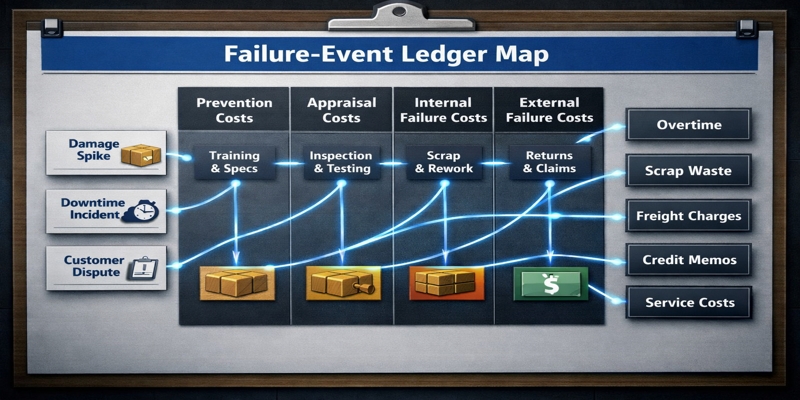
Building the Business Case for Packaging Quality: A CFO-Readable Justification Model for Operations and Finance
📌 Key Takeaways Finance rejects quality requests lacking definitional clarity, repeatable assumptions, and measurable controls—not because they oppose quality. Quality spend becomes defensible when failure events map to cost categories with measurement plans. Procurement managers and operations leads building CFO-ready quality cases will gain the justification framework and one-page template ... Read More
When Supply Chains Break: Mitigating Risk with Multi-Regional Corrugated Box Sourcing
📌 Key Takeaways Multi-regional sourcing prevents packaging crises by building qualified supplier alternatives across independent geographies before disruptions force emergency switches. The work happens before the crisis, not during it. Packaging procurement managers and operations leaders responsible for corrugated box supply chains will gain a systematic qualification framework here, preparing ... Read More