

📌 Key Takeaways
Waiting to switch packaging materials feels safer, but it actually makes the eventual change harder and riskier.
- Delay Transfers Risk Forward: Putting off a packaging transition doesn’t avoid problems—it just moves them to a future moment when you’ll have less time to solve them properly.
- Outside Deadlines Won’t Wait: Rules like the EU’s packaging regulation (applying from August 2026) arrive on fixed schedules, regardless of whether your team is ready.
- New Materials Need New Thinking: Folding cartons don’t behave like plastic—rushing the switch without adjusting your specifications leads to production failures.
- Teams Drift Apart Over Time: The longer you wait, the harder it becomes to get procurement, engineering, brand, and sustainability working from the same plan.
- Early Action Means Calmer Action: Starting sooner gives your team room to test, learn, and adjust before external pressure forces rushed decisions.
Control your timeline now, or external deadlines will control it for you.
Packaging and procurement teams preparing for a plastic-to-folding carton transition will gain a clear framework for building internal alignment, guiding them into the methodology and readiness tools that follow.
~ ~ ~ ~ ~ ~ ~ ~ ~ ~ ~ ~ ~ ~ ~ ~ ~ ~
Waiting feels safer. It isn’t.
The calendar fills up, the quarter closes, and the packaging transition conversation gets pushed again. Leadership wants more certainty. Operation wants fewer disruptions. Everyone agrees the move from rigid plastic to folding cartons matters—eventually.
But delay is not a neutral pause. It’s an active choice that compounds risk with every passing quarter. External sustainability mandates, retailer requirements, and supply chain pressures don’t wait for internal alignment. When they arrive before your team is ready, the transition you hoped to control becomes a scramble you’re forced to survive.
The three strategic risks of delaying your packaging transition:
- Compliance scramble — External mandates arrive faster than internal readiness, forcing reactive decisions.
- Rushed substitution — Compressed timelines lead to un-engineered material swaps that skip critical structural work.
- Internal misalignment — Cross-functional teams drift apart, making coordination harder under pressure.
Why Delaying a Packaging Transition Feels Safe but Increases Strategic Risk
Teams delay for understandable reasons. Current packaging lines are running. Stakeholder alignment conversations are difficult. The right moment never quite arrives.
Some organizations delay to protect operational stability. Others are avoiding the friction of cross-functional coordination. Many simply want more certainty before committing resources to a transition that touches procurement, engineering, brand, and sustainability simultaneously.
These instincts aren’t wrong. They’re just incomplete.
Delay feels like risk avoidance, but it’s actually risk transfer. Every quarter that passes without preparation shifts the eventual transition closer to whatever external deadline arrives first—whether that’s a regulatory requirement, a retailer mandate, or a supply chain partner’s sustainability policy. The EU’s Packaging and Packaging Waste Regulation (PPWR) framework represents one example of how compliance timelines can move faster than internal planning cycles.
Preparation determines whether external pressure becomes a catalyst for innovation or a trigger for operational failure.
How Delay Turns Sustainability Pressure into a Compressed Timeline
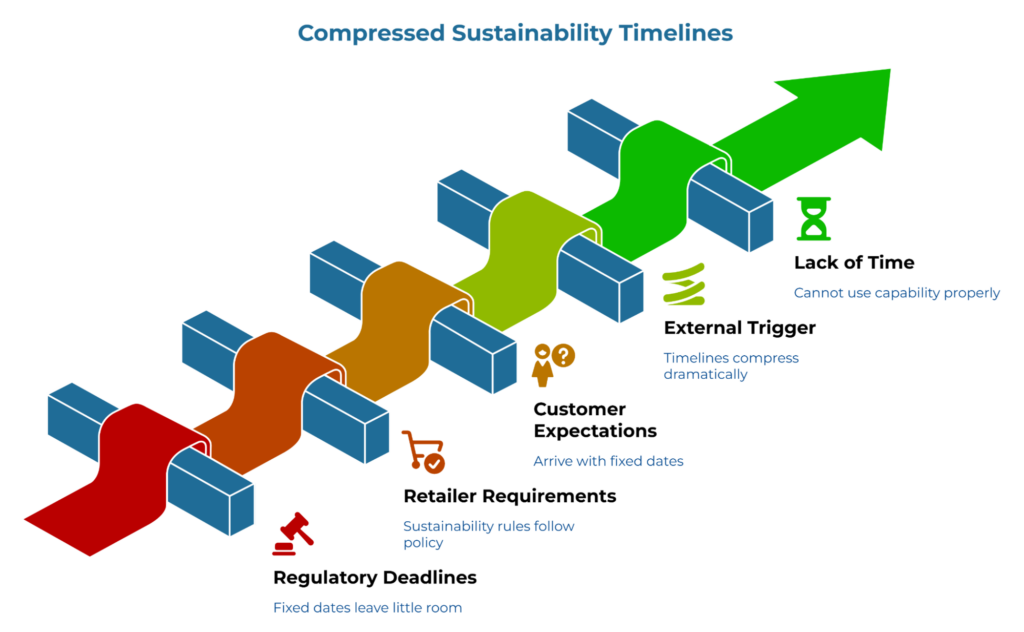
External pressure doesn’t wait for internal alignment. Regulatory deadlines, retailer sustainability requirements, and customer expectations can arrive with fixed dates that leave little room for methodical preparation.
Consider the European Union’s Packaging and Packaging Waste Regulation. Following its formal legislative adoption in late 2024, it entered into force 20 days after publication in the Official Journal of the European Union, generally applying 18 months thereafter. For teams selling into affected markets, that timeline is a reminder that packaging rules follow policy calendars, not internal comfort levels.
When a transition is triggered by external pressure rather than internal planning, timelines compress dramatically. Teams that expected months of preparation find themselves working in weeks. The controlled pilot becomes an emergency substitute. The careful specification work gets skipped in favor of speed.
This compression is where transition failures typically begin—not because the team lacked capability, but because they ran out of time to use that capability properly.
Consider the difference: a team with eighteen months can baseline current requirements, develop buyer-owned specifications, align stakeholders, run controlled pilots, and then engage suppliers from a position of clarity. A team with three months skips most of that sequence and hopes the supplier figures out the rest.
The first team controls the transition. The second team survives it—maybe.
Why Rushed Material Swaps Fail When Teams Skip Methodology
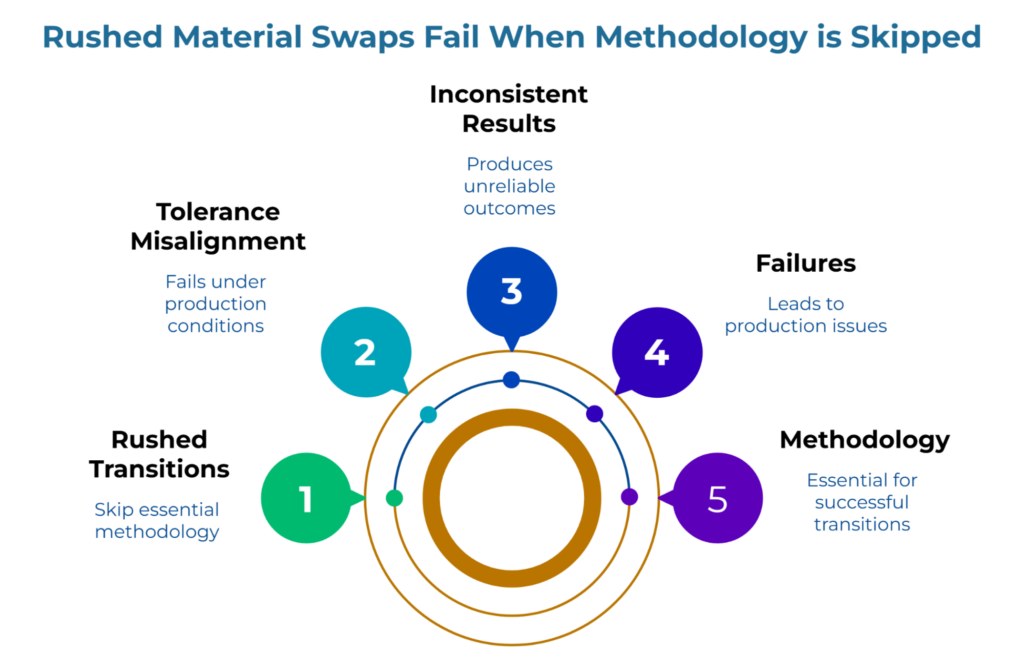
Here’s the core problem with late transitions: folding cartons are not a drop-in replacement for rigid plastic. Understanding how to transition from rigid plastic to folding cartons requires methodical structural work that rushed timelines rarely accommodate.
The two materials behave differently under stress, moisture, and handling. They have different tolerance profiles, different barrier properties, and different interactions with automated filling lines. A specification that worked perfectly for plastic packaging may produce failures when applied directly to paperboard.
Think of it as translating a book into a new language. The core story remains the same, but the grammar and structure must be completely rewritten to work. You can’t just swap words one-for-one and expect coherent sentences.
Rushed transitions skip this translation work. Teams under time pressure often take the shortest path: requesting quotes based on existing plastic specifications, assuming suppliers will figure out the conversion, or treating the switch as a simple material substitution. Shortcut logic is where failures begin.
The result is tolerance misalignment that shows up on the filling line. Folding cartons that looked acceptable in samples fail under production conditions. Specifications that were never normalized across suppliers produce inconsistent results—a problem that specification-true normalization is designed to prevent. Engineering discovers problems during production that should have been caught in design.
These failures aren’t random. They’re the predictable outcome of relying on supplier-led specifications instead of executing rigorous structural translation and barrier-requirement mapping.
Where Internal Misalignment Usually Shows Up First
Packaging transitions touch multiple functions, each with legitimate but different priorities.
- Sustainability wants movement toward compliance and certification alignment. They see delay as accumulating risk.
- Procurement wants specification comparability and sourcing clarity. They see action without clear specifications as risk.
- Engineering wants tolerance alignment and confidence that new materials will run on existing lines without disruption. They see untested materials on production lines as a risk.
- The brand wants shelf presence and aesthetic continuity. They see rushed packaging changes affecting customer perception as risk.
Each function is correct from its own perspective. The problem is that delay sharpens these conflicts rather than resolving them.
When transition planning starts early, these priorities can be sequenced and reconciled. A shared framework for sustainable folding carton sourcing gives Procurement and Sustainability a common language. Engineering gets time to validate structural assumptions. Brand gets room to test aesthetic options.
When transition planning starts late, these conversations happen under pressure—or don’t happen at all. Functions make independent assumptions. Decisions get made in silos. The first visible failure often isn’t a production problem; it’s the discovery that different teams were working toward different readiness thresholds.
What a Proactive, Methodology-First Transition Actually Looks Like
A methodology-first transition follows a specific sequence: define functional requirements, normalize technical expectations, align stakeholders, test and pilot, then source.
This sequence matters.
Sourcing before specification alignment produces the tolerance failures described above. Specification work before stakeholder alignment produces internal conflict. Stakeholder alignment before functional requirements produces vague agreements that collapse under technical scrutiny.
The practical starting point is an empirical baseline of current functional performance—quantifying mechanical requirements beyond visual aesthetics: what barrier properties does it provide? Furthermore, defining Cobb value standards before requesting quotes prevents the specification chaos that rushed transitions create. What tolerances does your filling line require? Understanding how GSM accuracy fails without moisture content control helps teams identify the tolerance variables that matter most. What handling stresses must it survive? What certification or compliance requirements apply, particularly for food-contact applications?
This baseline work is precisely what rushed transitions skip—and exactly what the first 72 hours of a sustainable folding carton transition should establish.
From that baseline, you can translate environmental mandates into sustainable folding carton specifications that suppliers can quote against consistently. These buyer-owned specifications—structured through a baseline packaging parameter checklist—become the foundation for supplier conversations, not the output of them.
The goal is operational continuity: a transition that maintains line performance, brand presentation, and compliance standing while changing materials. That goal requires methodology before sourcing.
Internal Alignment Assessment: Pilot Readiness Thresholds
Before initiating a packaging transition, use this assessment to determine whether your organization is positioned for controlled action or at risk of a rushed scramble.
| Readiness Question | Optimal | Partial | Critical |
| Is there documented agreement on why this transition is happening—compliance, customer demand, brand positioning, or supply chain pressure? | |||
| Has someone been assigned clear ownership of structural and tolerance requirements for the new material? | |||
| Are current line tolerances and filling-speed assumptions documented and accessible to the transition team? | |||
| Are compliance and certification requirements clearly defined for your target markets and product categories? | |||
| Are Procurement and Engineering working from the same definition of “ready to proceed”? | |||
| Is the team prepared to run a controlled pilot, or still debating whether to act at all? |
Interpreting your results:
- Mostly green: Ready to start a pilot. Your organization has the alignment foundation to move forward with controlled testing.
- Mixed green and yellow: Needs cross-functional alignment first. Address the partial-alignment areas before committing to supplier conversations or pilot timelines.
- Any red answers: At risk of a rushed transition. Unresolved fundamentals will surface as conflicts or failures later. Prioritize internal alignment before external action.
The objective is to distinguish between methodical action and reactive decision-making.
Strategic Conclusion
Delaying a packaging transition doesn’t reduce risk. It transfers risk from the present to the future, where compressed timelines and external pressure make controlled action harder.
The alternative is a proactive, methodology-first approach: baseline your current requirements, align your stakeholders, develop buyer-owned specifications, and then engage suppliers from a position of clarity. A team that starts earlier doesn’t commit to a reckless transition. It creates the conditions for a calmer one—clearer requirements, stronger internal alignment, and a pilot that leadership can approve because it looks controlled rather than improvised.
If you’re trying to convince hesitant leadership to approve a pilot budget, this framing may help: the question isn’t whether to spend resources on transition planning. It’s whether to spend those resources now, when you control the timeline, or later, when external deadlines control it for you.
For deeper guidance on sustainable packaging transitions, specification development, and cross-functional alignment, explore the resources available in PaperIndex Academy.
When your internal requirements are clearly defined, you can browse folding carton suppliers with the specification clarity needed to evaluate options effectively.
Disclaimer:
This article discusses strategic considerations for packaging transitions and is for educational purposes only. Regulatory timelines, compliance requirements, and market conditions vary by jurisdiction and change over time. The EU PPWR reference is illustrative; verify current regulations for your markets. Organizational readiness assessments are general frameworks—actual transition planning requires evaluation of your specific operations, products, and supply chain conditions.
Our Editorial Process:
Our expert team uses AI tools to help organize and structure our initial drafts. Every piece is then extensively rewritten, fact-checked, and enriched with first-hand insights and experiences by expert humans on our Insights Team to ensure accuracy and clarity.
About the PaperIndex Insights Team:
The PaperIndex Insights Team is our dedicated engine for synthesizing complex topics into clear, helpful guides. While our content is thoroughly reviewed for clarity and accuracy, it is for informational purposes and should not replace professional advice.