
📌 Key Takeaways
Tamper-evident features change how folding cartons behave on the line—treat them as structural engineering changes, not artwork additions.
- Baseline Before You Change: Document your current folding carton specifications and machine settings first so you can spot which problems come from the new design versus old issues.
- Every Feature Leaves a Mark: New perforations weaken board strength, seals shift weight, and indicator flaps change closing angles—each affects how the folding carton moves through each station.
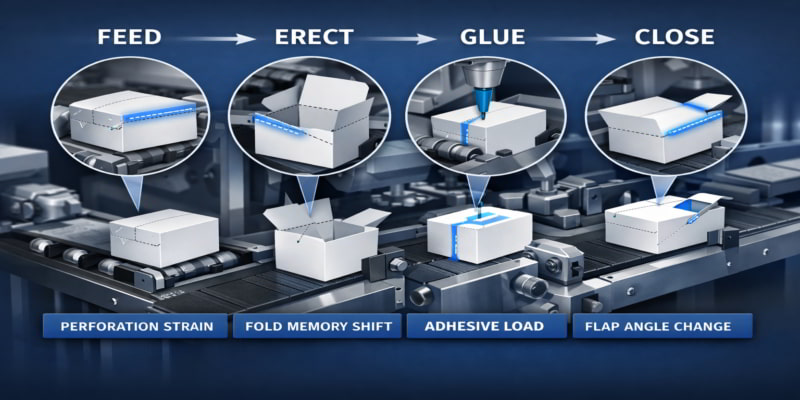
- Map Changes Station by Station: Walk through feed, erection, glue, and closing to predict where the new feature might cause jams before you run a single trial.
- Samples Prove Nothing Without Repeatability: A folding carton that works in a controlled trial can still fail in production if suppliers can’t hold the same tight tolerances batch after batch.
- Artwork Approval Is Not Structural Approval: A design that looks right on screen can behave wrong at speed—structural review must happen alongside visual sign-off.
Engineer the feature, not just the graphic, and line stability follows.
Packaging engineers and procurement managers integrating tamper-evident folding cartons into pharmaceutical or medical device lines will find a ready-to-use workflow here, preparing them for the detailed five-step methodology that follows.
~ ~ ~ ~ ~ ~ ~ ~ ~ ~ ~ ~ ~ ~ ~ ~ ~ ~
Engineering approved the redesign. Quality signed off on the print proofs. Then the first trial run logged 14 jams in 20 minutes.
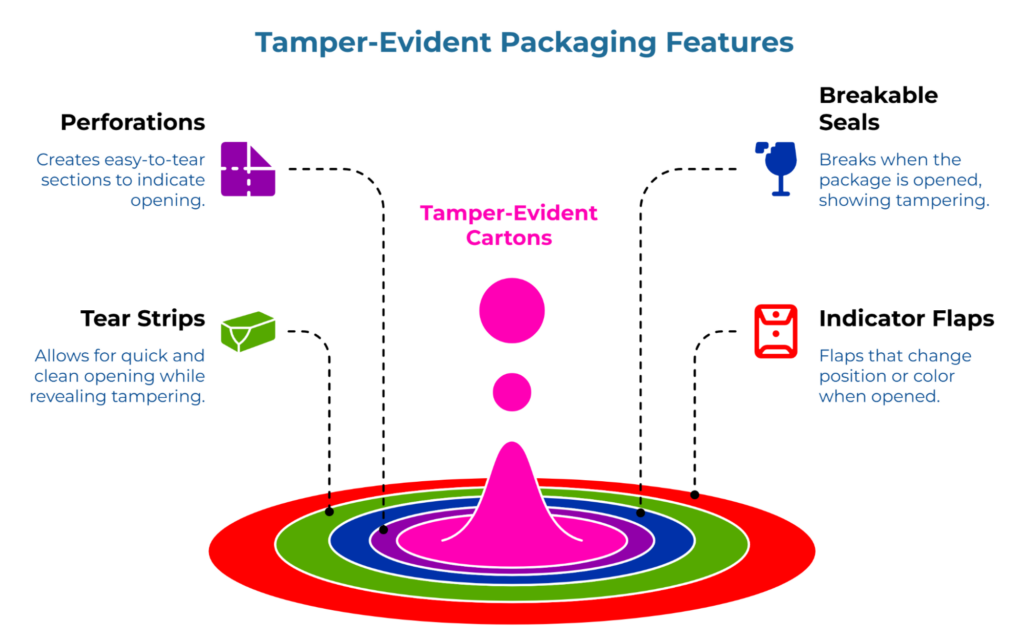
Tamper-evident medical cartons are folding cartons engineered with structural features—perforations, breakable seals, tear strips, or indicator flaps—that reveal whether a package has been opened before reaching the end user. These folding cartons serve pharmaceutical, nutraceutical, and medical device manufacturers who must comply with regulations such as the FDA’s tamper-evident packaging requirements for over-the-counter (OTC) human drug products (21 CFR 211.132) in the US, or the European Commission’s Falsified Medicines Directive (FMD), which mandates both unique identifiers and anti-tampering devices in the EU—requirements that intersect with the pharma-grade board specification challenges explored elsewhere in this series. While the U.S. Drug Supply Chain Security Act (DSCSA) primarily focuses on serialization and interoperable electronic tracing, physical tamper-evident features are often integrated concurrently to ensure comprehensive supply chain integrity.
Treating these features as graphic additions rather than structural changes creates the failure point. A new perforation alters fold memory. A breakable seal shifts weight distribution. An indicator flap changes closing geometry. When these mechanical realities collide with an auto-cartoner calibrated for a different folding carton profile, the line jams.
The concern that adding tamper-evident features might require new capital equipment is understandable. In most cases, however, it proves unfounded—provided teams map structural changes against existing machine tolerances before production begins.
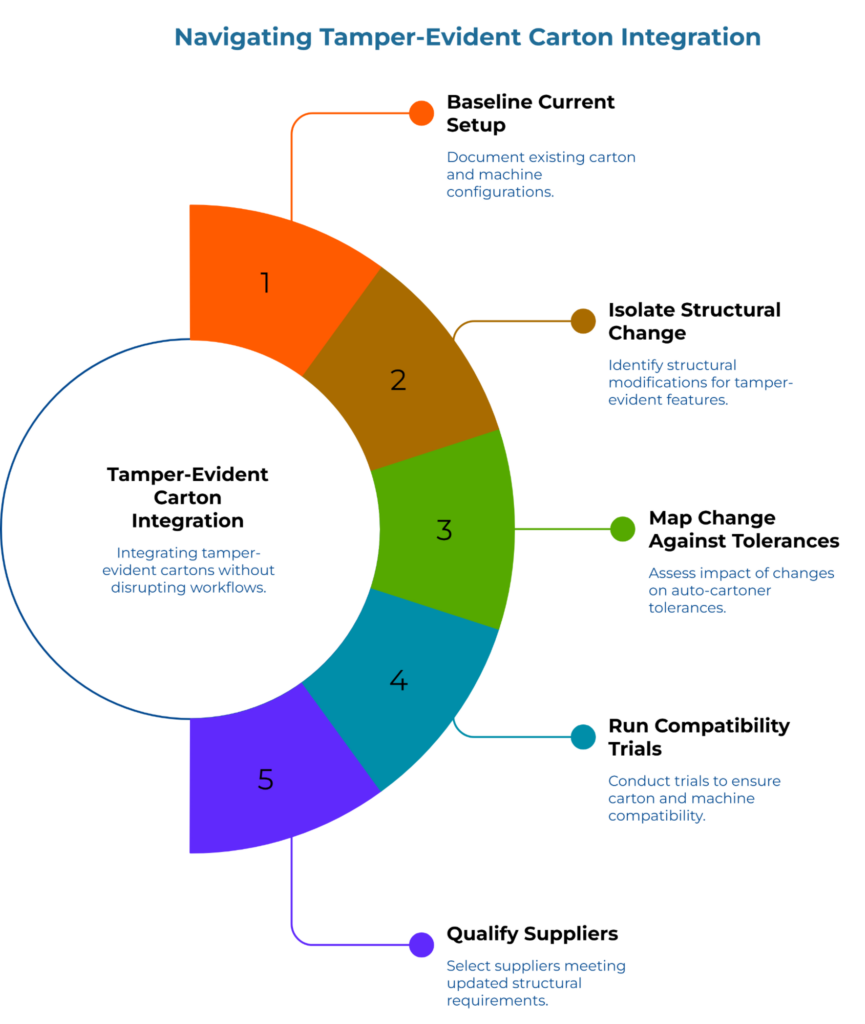
To integrate tamper-evident medical folding cartons without breaking packaging workflows, teams should:
- Baseline the current folding carton and machine setup
- Isolate the structural change introduced by the tamper-evident feature
- Map that change against auto-cartoner tolerances
- Run controlled compatibility trials
- Qualify suppliers against the updated structural requirements
Why Tamper-Evident Upgrades Break Workflows When Added Too Late
Tamper-evident features belong to a broader family of anti-counterfeiting and serialization features in folding cartons for pharmaceutical packaging—a category that includes track-and-trace packaging elements, 2D matrix print tolerances for DSCSA-compliant folding cartons, and pharma folding carton serialization requirements. What distinguishes this spoke of that cluster is the physical integration challenge: tamper-evident additions change how the folding carton behaves on the line.
When a tamper-evident redesign enters the workflow late—after artwork approval, after tooling commitments—engineering teams inherit a structural change they did not specify. A tear strip that looks simple on screen introduces a perforation line that reduces localized board strength. A breakable glue seal adds adhesive mass to a surface the auto-cartoner was never calibrated to handle.
Workflow problems originate in structural design, not in machine operation alone—a pattern that mirrors the price of misalignment in folding carton, where tolerance failures cascade into downtime and disputes. The carton that jams at the erecting station is not defective; it is behaving according to its new structural properties. The machine that rejects it is not malfunctioning; it is responding to tolerances that no longer match.
Approval of a tamper-evident redesign must never rely solely on artwork review. Artwork shows what the folding carton looks like. It does not show how the folding carton behaves during feed, erection, or closing. Structural review must accompany visual approval.
Baseline the Current Folding Carton-and-line Configuration
Before modifying any design, document the current state. This baseline becomes the reference for every tolerance comparison that follows.
Folding carton architecture baseline: Record board grade, caliper, current fold pattern, score depths, existing glue zones, adhesive specifications, flap dimensions, and tuck geometry—parameters covered systematically in the baseline packaging parameter checklist. Note any known sensitivities—areas where the current folding carton occasionally causes hesitation or requires operator adjustment.
Line configuration baseline: Document the auto-cartoner model, current speed settings, feed mechanism type, erecting station tolerances, glue application parameters, and closing/discharge settings. Identify which stations have historically been most prone to disturbance with the current folding carton.
This step is not optional. Without a frozen baseline, engineering cannot distinguish between problems caused by the tamper-evident change and problems inherited from prior configuration drift. As explained in why folding carton clarity matters before supplier review starts, undefined tolerances create preventable workflow risk that compounds when new structural variables enter the system.
Identify Structural Changes From Tamper-Evident Features
Identify exactly what the tamper-evident feature changes about the folding carton’s physical behavior. The goal is not to catalog feature types generically but to show that every addition leaves a mechanical footprint the line will feel.
Perforation-based features such as tear strips and breakaway tabs reduce localized board strength along the perforation line, a structural consideration that parallels the tolerance alignment issues discussed in the folding carton specification alignment checklist. This affects fold memory: the folding carton may flex differently at feed or resist erection at a different force threshold than before.
Seal-based features including breakable glue seals and tamper bands add adhesive mass to surfaces that previously had none. Weight distribution shifts. Absorption characteristics at glue zones change. The folding carton may sit differently in the magazine.
Indicator-based features like tuck-flap indicators and push-through closures modify closing geometry. A flap that previously tucked cleanly may now require a different insertion angle or force to achieve consistent closure.
A new perforation or glue flap significantly alters fold memory, often introducing enough variance to trigger line instability. Even small changes to score depth or adhesive placement can shift how the folding carton moves through each station.
Document the specific change: where it occurs on the folding carton, what physical property it affects—stiffness, fold memory, weight, absorption—and which machine stations will encounter that change first.
Align New Structural Geometry with Auto-Cartoner Tolerances
This is the heart of the integration workflow. With the baseline documented and the structural change isolated, compare the two systematically. The reader should approach this section as an engineering review, not a theoretical exercise.
Feed behavior: Does the new perforation or seal affect how folding cartons separate from the magazine? Will the feeder’s suction cups or friction mechanisms grip the modified surface reliably? A perforation line near the leading edge can catch or release differently than the original solid board.
Erection behavior: Does the altered fold memory change the force required to open the folding carton? Will the erecting mechanism over-travel or under-travel given the new resistance profile? Seal-based features that add adhesive mass near fold lines often require recalibration here.
Flap presentation: Do modified flaps present to the glue station at the expected angle and timing? Has the weight distribution shift affected how the folding carton indexes through the line? Indicator flaps with altered geometry may lag or lead their expected position.
Glue application consistency: Will the adhesive deposit correctly onto a surface that now has a perforation, coating, or additional seal material? Has the absorption rate changed? A tamper seal that adds a second adhesive layer can interfere with primary glue bonding if the two adhesives are incompatible.
Closing and discharge stability: Does the tamper-evident feature interfere with the closing sequence? Will the finished folding carton discharge cleanly, or does the new geometry catch on guides or rails?
This mapping exercise should produce a station-by-station risk assessment. Stations with no expected impact can be cleared. Stations with potential impact require trial validation before production release.
For teams managing multiple folding carton formats, the specification bridge: a practical blueprint for folding carton requirements across multiple SKUs provides a framework for standardizing tolerance documentation across packaging families.
Execute Controlled Compatibility Trials
Do not proceed to full production based on tolerance mapping alone. Run short engineering trials to confirm that mapped risks behave as predicted—or to discover risks the mapping missed.
Trial structure: Use production-representative folding carton samples, not hand-made prototypes. Run at target line speed, not reduced speed. Observe each flagged station for the specific behavior predicted in the mapping step.
What to record: Document jam frequency by station, folding carton orientation at jam point, whether jams correlate with specific folding carton positions in the run, glue deposit consistency across the trial batch, and discharge alignment. Note any manual interventions required to complete the run.
Handoff notes for quality and operations: The trial is not complete until observations are documented in a format that quality and operations teams can act on. Record which stations passed without issue, which required adjustment, what adjustments were made, and what monitoring should continue into early production runs.
The goal at this stage is operational confirmation, not statistical validation. If trials reveal unexpected behavior, return to Step 2, refine the structural change description, and re-map before attempting another trial.
Standardize Supplier Qualification for Scalability
A successful trial proves that a specific sample batch works on a specific line. It does not prove that suppliers can hold those structural requirements repeatedly across production volumes.
Tamper-evident features depend on precise execution. Perforation depth must stay consistent. Seal adhesive must be deposited within specification. Fold scores must maintain the memory profile that passed the trial. When moving from engineering design into supplier evaluation, these parameters become qualification criteria.
Verify supplier repeatability before concluding that a successful sample run guarantees production-level performance. The folding cartons that passed the trial were produced under controlled conditions. Production volumes introduce variation, a challenge addressed by cross-SKU material standardization frameworks that maintain specification discipline during scale-up. Qualify suppliers against the specific tolerances your line requires, following the comprehensive folding carton supplier verification methodology to sequence proof collection before quotes arrive.
Before scaling, update supplier qualification requirements to include the structural parameters that emerged from integration. The folding carton specification alignment checklist: connecting compliance to supplier vetting provides a framework for translating engineering requirements into supplier evaluation criteria.
For guidance on structuring folding carton requirements so suppliers can quote accurately against your specifications, see how to build quote-ready folding carton fields without making suppliers guess.
What to Document Before Approving the Final Tamper-Evident Folding Carton
Before sign-off, assemble the evidence pack that operations, quality, and procurement need for ongoing management. This checklist becomes the handoff document between the integration project and production.
Auto-Cartoner Compatibility Checklist
| Checkpoint | Status | Owner | Notes |
| Current folding carton baseline documented | ☐ | Engineering | Board grade, fold pattern, glue zones, flap geometry |
| Tamper-evident feature type identified | ☐ | Engineering | Perforation / seal / indicator / other |
| Fold memory impact assessed | ☐ | Engineering | Location and magnitude of stiffness change |
| Glue/perforation tolerance verified | ☐ | Engineering | Adhesive deposit and perforation depth within spec |
| Machine compatibility mapped | ☐ | Engineering | Station-by-station tolerance comparison complete |
| Feed and erecting compatibility confirmed | ☐ | Operations | Observed behavior matches mapped predictions |
| Short-run trial results logged | ☐ | Quality | Jam frequency, location, resolution notes attached |
| Supplier structural capability qualified | ☐ | Procurement | Repeatability evidence for critical parameters |
| Final approval recorded | ☐ | All | Engineering / Quality / Operations sign-off |
This checklist should travel with the folding carton specification so that future reorders or supplier changes trigger the same structural review.
Tamper-evident medical folding cartons address real regulatory requirements. The FDA’s tamper-evident packaging requirements for certain OTC human drug products establish the legal mandate for these physical security features, while standards like the GS1 DataMatrix guidelines for healthcare applications drive the parallel need for traceable, serialized data. The integration workflow above addresses how to implement them without disrupting operations.
By treating tamper-evident features as structural engineering changes rather than artwork additions, packaging teams can integrate security upgrades while preserving line performance. The integration protocol requires a rigorous sequence: establishing a baseline, isolating mechanical shifts, mapping against machine tolerances, and verifying supplier repeatability through controlled trials.
This workflow prepares teams not only for current implementation but for future supplier evaluation. When structural requirements are documented and proven, folding carton supplier selection becomes a question of capability evidence rather than assumption.
For additional educational resources on folding carton specifications and supplier qualification, explore the PaperIndex Academy. When structural requirements are defined and documented, folding carton suppliers can be evaluated against the specific capabilities your line requires.
Disclaimer
This article is for educational purposes only and is not legal, regulatory, validation, or line-qualification advice. Packaging teams should confirm tamper-evident, serialization, and line-compatibility requirements against applicable regulations, internal validation protocols, and supplier-specific engineering data before implementation.
Our Editorial Process:
Our expert team uses AI tools to help organize and structure our initial drafts. Every piece is then extensively rewritten, fact-checked, and enriched with first-hand insights and experiences by expert humans on our Insights Team to ensure accuracy and clarity.
About the PaperIndex Insights Team:
The PaperIndex Insights Team is our dedicated engine for synthesizing complex topics into clear, helpful guides. While our content is thoroughly reviewed for clarity and accuracy, it is for informational purposes and should not replace professional advice.